Why you need your Texas LTC
With the passing of the Firearms Carry Act of 2021—HB 1927, also known as Texas Constitutional Carry, carrying guns without a Texas License to Carry (“LTC”) is becoming reality. If you are wondering what that means for your existing LTC or if you should bother getting an LTC at all, the short answer is yes, an LTC is good to have. Read on for details about Texas Constitutional Carry, how to get your LTC, and why it is such a great idea to have a license in the first place.
With HB 1927 now in effect, people legally allowed to own and carry firearms will be able to carry their guns without a permit in Texas—to a point. This is where having your LTC comes in handy. The new law does not allow you to carry anywhere and everywhere. That means if you want extra freedom in where you can carry—including in other states—you will need an LTC.
Getting your LTC is easy if you meet the state requirements. If you are legally allowed to own a firearm under state or federal law, you will take a short course taught by a state-licensed LTC instructor and do some paperwork. The course includes classroom and range hours. Classroom hours can be taken virtually instead of in person if they meet the state-mandated minimum of four hours. SixEight Tactical offers a state approved course. The virtual class is simple and straightforward and involves a series of videos and a 25-question test at the end.
Once you spend time on the classroom portion of the course, you can move on to range time. A minimum of one hour of range time, ending with a live-fire test, is required by the State of Texas. You need 50 rounds of ammunition (worth up to 5 points apiece) for the test and must score a minimum of a 70% score to pass. For those who are curious about it, other details include:
- A B-27 target (silhouette target measuring 45 inches high and 24 inches wide)
- 250 possible points, 175 points minimum to pass
- All shots are fired from the ready position, meaning there is no holster use
- Shots are fired from three distances: 3 yards, 7 yards, and 15 yards
The cost for the course can vary by instructor and is separate from the fee you pay to the state to process your LTC. At the time of this writing, the processing fee the state charges are only $40. After you pass the written and live-fire tests, you will have to fill out the application. The following are a few things the State of Texas will need from you to get the paperwork done:
- Valid driver’s license or identification card
- Current demographic, address, contact, and employment information
- Residential and employment information for the last five years (new applicants only)
- Information regarding any psychiatric, drug, alcohol, or criminal history
- Valid email address
- Valid credit card
- Fingerprints
- FBI criminal history background check
You can find the application and related information on the Texas DPS website. Fingerprinting is a simple process. Fingerprinting is done by appointment, and you can find fingerprinting services locations at www.identogo.com. The State of Texas has up to eight weeks to process your application and all the paperwork that goes with it. If they do not get back to you in that time, you can submit a query to check on it.
The process to obtain an LTC might sound overwhelming, but it is easy and well worth the time. A major benefit of having an LTC means purchasing firearms from a Federal Firearms Licensee (“FFL”) is a smoother transaction because you have already had a background check. You can also carry your gun in places and states you would not be allowed to carry in without an LTC. So many people get through the classroom portion and never pursue it further than the range, let me encourage everyone, FINISH IT!
Where can I carry with an LTC?
There are places where you can carry your firearm only if you have a valid Texas LTC; if you do not have an LTC and are carrying under HB 1927, you will not be allowed to carry in some areas. This is just one reason you still want your LTC, even with HB 1927 passing. Without your LTC, you will still be restricted from certain locations, including:
- On school premises, such as locked in your car or on your person while you are driving down a side street within 1,000 feet of the school. Without an LTC, you cannot have your firearm within 1,000 feet of a public, parochial, or private school. Of course, even with an LTC, you cannot carry inside the school without the school’s written regulation allowing it or with written authorization from the school.
- On the Lower Colorado River Authority property in Central Texas.
- In a restaurant, with a restaurant being defined by law as obtaining 50% or less of its revenue from alcoholic beverage sales. Restaurant signs do not have a red 51% on them, and if they include the word “unlicensed” in reference to who cannot carry there, they are letting you know Texas LTC holders can still carry on the premises. LTC holders ARE licensed.
The 30.06 and 30.07 signs prohibiting LTC holders to carry in a business will still be posted and in effect. HB 1927 passing does nothing to change the legal nature of those signs. Things you should know about signs, your LTC, and HB 1927:
- Penal Code Chapter 30.05 signs will be used by businesses choosing to prohibit unlicensed people from carrying firearms in their places of business. HB 1927 does not allow you to carry in businesses with a properly posted 30.05 notice. More and more businesses have begun posting this sign, you NEED an LTC to carry beyond that sign legally.
- Businesses will continue to post 30.06 and/or 30.07 prohibiting Texas LTC holders from carrying concealed (30.06) or openly (30.07) in their place of business.
- The Texas Alcoholic Beverages Commission states businesses that qualify as bars—meaning they receive 51% or more of their income from sales of alcoholic beverages for consumption on the premises—must post a sign notifying customers of their 51% status. This is known as a Weapons Warning Sign but is sometimes referred to as a 51% sign. Neither your LTC nor HB 1927 allow you to carry a firearm in a bar.
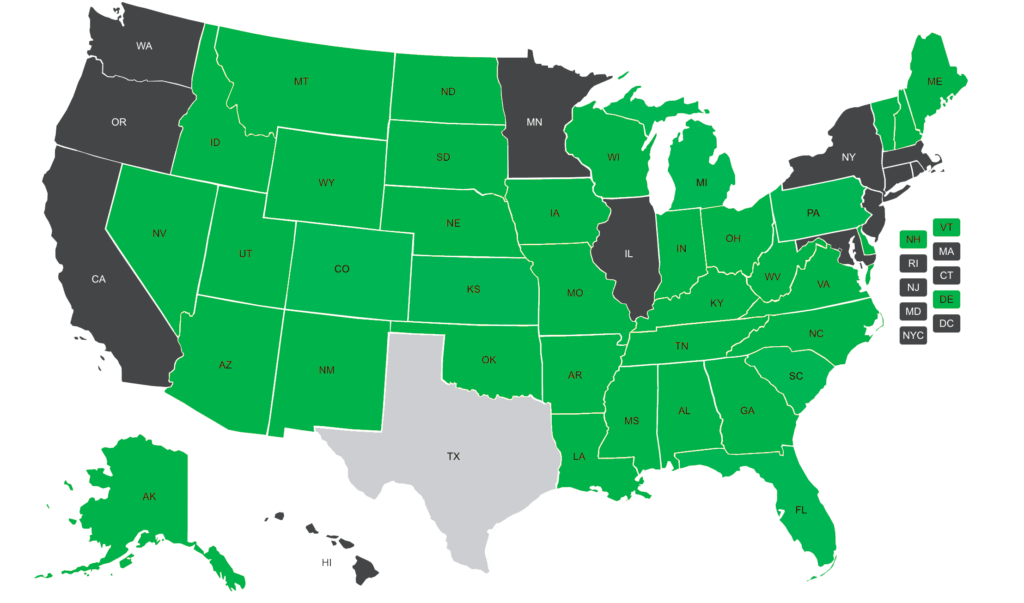
One of the best reasons to have a valid Texas LTC, aside from the ability to carry in additional places within the State of Texas, is reciprocity. Reciprocity refers to the other states’ agreements to recognize and honor your Texas LTC. Not all states offer reciprocity, but those that do will let you carry your firearm while you are in that state if you have a valid Texas LTC. As with carrying in any county or state, be sure you are familiar with the area’s specific laws and regulations before entering the area with your firearm. Ignorance of the law is never an excuse. The map below shows states in green with some form of reciprocity with Texas LTC holders. It is up to you to do your own research to determine what is and is not legal when traveling with your firearm.
If you are looking for an online class, we hope you choose us!
1439131
 SixEight-Tactical
Leave a comment