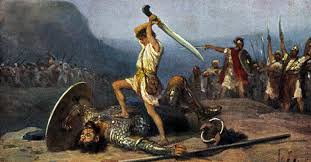
What does the Bible have to say about self-defense? Ultimately the question is one of stewardship. Think about it in these terms. The life that has been granted to each individual is a stewardship of the image of God made animated in us. In other words, we were created in the image of God and we have been granted stewardship of this life to preserve, to protect, to display that image. If stewardship is the key to this issue, then we have to think about self-defense in those terms.
The Bible has several guidelines related to self-defense. The first is the idea of preserving the image of God. Let me explain it to you this way. The Sixth Commandment says, “Thou shall not murder.” Murder is seen as an attack on God’s image and an expression of hatred toward God, whose image is expressed through the sacred life of an individual. If murder is an attack on God and an expression of hatred towards God, then personal protection must be viewed from the perspective of defending the image of God based on our love for Him and our desire to see it preserved and protected.
Theologians J.P. Moreland and Norman Geisler say that “to permit murder when one could have prevented it is morally wrong. To allow rape when one could have hindered it is evil. To watch an act of cruelty to children without trying to intervene is morally inexcusable. In brief, not resisting evil is an evil of omission, and an evil of omission can be just as evil as an evil of commission. Any man who refuses to protect his wife and children against a violent intruder fails them morally.”
In Genesis 14 when Lot is taken captive in a military moment, Abraham armed the men of his household and went and saved Lot. Not only was that seen as appropriate, but Melchizedek, a priest and a king in that generation, came and commended Abraham for his readiness and use of weapons to protect home and family.
In Exodus 22 there is explicit instruction given to Israel about the allowance of force in a threatening situation. Exodus 22 talks about a thief who breaks into a house. If he is killed in the commission of that burglary, there is no penalty for a homeowner.
Christians or even non-Christians who carry with a “wild west” mentality like they are looking for somebody they can use that weapon against are just flat out wrong. Self-defense in scripture is allowable. It is even commended. It is never based on hatred or revenge or any other ungodly motive. It is always about protection and preservation, stewardship, of those resources of family and possessions that have been placed into the hands of God’s people.
Difficult choices exist in this evil world. I hope that I never have to use deadly force to protect my family. But if I do, I know from my study of the Word of God that it is not wrong to use violence if necessary, to protect my family from violent criminal assault.
What about “turn the other cheek”?
The “slap” that Jesus says we should endure is speaking of personal slights of any kind. The slap (or the “smiting,” as the KJV has it) does not have to involve literal, physical violence. Even in our day, a “slap in the face” is a metaphor for an unexpected insult or offense. Did someone insult you? Let him, Jesus says. Are you shocked and offended? Do not be. And do not return insult for insult. Turn the other cheek. Turning the other cheek does not imply pacifism, nor does it mean we place ourselves or others in danger. Jesus’ command to turn the other cheek is simply a command to forgo retaliation for personal offenses. He was not setting government foreign policy, and He was not throwing out the judicial system. Crimes can still be prosecuted, and wars can still be waged, but the follower of Christ does not need to defend or avenge his honor. The slap was not a lethal blow.
“In Jesus’ day, hitting a person on the cheek was a forceful insult, but it was not considered a violent assault. Here, Jesus is specifying a strike on the right cheek, which implies a back-handed slap. Striking someone with the back of the hand could demand a doubled fine because it was “the severest public affront to a person’s dignity.” Jesus is not suggesting that his followers should stand around and take abuse. First, turning the left cheek was a bold rejection of the insult itself. Second, it challenged the aggressor to repeat the offense, while requiring that they now strike with the palm of their hand, something done not to a lesser but to an equal. In other words, turning the other cheek strongly declares that the opposer holds no power for condescending shame because the victim’s honor is not dependent on human approval—it comes from somewhere else. This kind of action reshapes the relationship, pushing the adversary to either back down or to treat them as an equal.” (bibleproject.com)
I used to wonder how Jesus, lover of truth and doer of justice, could tell us to sit back and accept lies and injustice in this manner. But then I stumbled onto Dr. Walter Wink’s exegesis of the Sermon on the Mount in Jesus and Nonviolence: A Third Way, and now I have a much more refined understanding.
Wink starts his exegesis by looking at the phrase, “do not resist an evildoer.” He explains that a more accurate translation of this sentence is “do not retaliate against violence with violence” or “don’t react violently against the one who is evil.” This subtle yet powerful shift in language sets a whole new tone for what follows: rather than being told not to resist, the people gathered to hear Jesus are told not to resist violently.
Wink goes on to examine the phrase “if anyone strikes you on the right cheek, turn the other also.” Why, Wink asks, does Jesus reference the right cheek specifically? The answer is both enlightening. Jesus lived in a right-handed world where left hands were reserved only for unclean tasks. Therefore, we can assume that the person doing the hitting would have used their right hand. The only way to strike someone on the right cheek with your right hand is a backhanded slap. Such a blow connotes an insult, not a fistfight, and was a normal way to reprimand someone over whom you had power (e.g., masters to slaves, husbands to wives, Romans to Jews). To strike your equal in such a manner was socially and legally unacceptable, carrying with it a huge fine.
With this new understanding of the context Jesus was speaking in, picture the scenario with yourself as the aggressor. You are a wealthy, powerful person whose slave has displeased you in some way. You reprimand your slave with a backhanded slap. The response you expect is the response you have always received from your slaves – the response you would give if someone higher than you treated you the same way. You expect your slave to cower, submit, and slink away. Instead, your slave defiantly turns their other cheek and challenges you to hit them again. What can you do?
You would like to give your slave another backhanded slap to show them their place, but to do that you would have to use your left hand which would admit that your action is unclean. You could hit them on their left cheek, instead, but it would be embarrassing to hit your slave the way you should hit your equal. You are confused. You do not know what to do. Flustered, you could order the slave to be flogged, but the slave has already made their point. They have shown you that they are a human person with dignity and worth. You do not own them, you cannot control them, and they do not submit to your rule.
I know, I lost you at slave. Rather than letting a word offend us, we should view history with the proper lens it requires, the lens of that day, not our modern-day lens. We can never fully grasp complete context without knowing the times, what the customs were, what the traditions were, what the environment was like, the classes of people, and the laws of the time. It is not enough to know them, but we must understand the whys.
The Bible teaches in various places that a believer may act in self-defense or defense of others without sinning, including acts of defense that involve taking the life of another when necessary.
Some turn to the sixth commandment’s prohibition against murder to claim that the Bible prohibits taking any life under any circumstances, but this is not a correct interpretation. The word murder means, by definition, the unlawful taking of life. Exodus 20 uses the Hebrew word for murder (ratzach) rather than the word for kill (harag) to acknowledge some forms of killing are justified and therefore not sin.
According to scripture, lawful forms of killing include during wartime against enemies of peace, by the government as a just punishment for crime, in self-defense, and in defense of others.
Even Jesus implied the need for his disciples to prepare for self-defense against those who might threaten them as fellow “transgressors” once Jesus had been condemned, so He gave these instructions: And he said to them, “When I sent you out with no moneybag or knapsack or sandals, did you lack anything?” They said, “Nothing.” He said to them, “But now let the one who has a moneybag take it, and likewise a knapsack. And let the one who has no sword sell his cloak and buy one. For I tell you that this Scripture must be fulfilled in me: ‘And he was numbered with the transgressors.’ For what is written about me has its fulfillment.” And they said, “Look, Lord, here are two swords.” And he said to them, “It is enough.” Luke 22:35-38
Jesus did not press for more swords or for every man to be armed, they were not to be an army of aggressors, but they had the means to defend themselves. We tend to overlook the fact he told them to sell their cloak and buy a sword. The cloak back then was one of their most important garments, it protected them from the elements and kept them warm at night, get rid of it and buy a sword, that is profound.
How we decide to defend (fists, knives, or guns) ourselves is not necessarily what it important as long as our actions do not go beyond the reasonable need for self-defense and turn to vengeance, as Paul says: Repay no one evil for evil, but give thought to do what is honorable in the sight of all. If possible, so far as it depends on you, live peaceably with all. Beloved, never avenge yourselves, but leave it to the wrath of God, for it is written, “Vengeance is mine, I will repay, says the Lord.” Romans 12:17-19.
Paul tells us to remain at peace with men so long as the situation depends on our choices and actions. On the other hand, if another breaks the peace with us, then we are justified to act in defense so long as we do not move to act in vengeance. Acting in vengeance is initiating revengeful conflict out of malice for another while self-defense is acting without malice to halt or prevent the attack of another. If our actions shift from halting an attack to prosecuting our own attack, then we have crossed the line into sin.
Keep in mind Paul’s command for believers to seek for peace with others to the degree possible assumes we will make every effort to avoid potential conflict before it escalates to violence. The Bible’s acknowledgment of the right to act in self-defense cannot become a license for us to choose a violent response when other, non-violent options were still available.
Finally, as Jesus advised in Luke 22 a Christian may take prudent measures to mitigate potential risks, including taking self-defense courses, lawfully carrying weapons, or even acting preemptively against a threat when required to protect life or property. Any actions we take must be in keeping with the laws of our land since Christians are also required to obey and uphold the law.
The key test for whether we act properly under any circumstances is determined by the motives of our heart. If we act with evil intentions, then we sin, if we act to end evil and protect the innocent, then we do not sin. In the end, we all have to decide for ourselves if carrying a weapon is proper or not. We have a right as an American citizen to own and carry them, how your world view and biblical view lines up will determine whether you carry or not.
If you decide you have an interest in carrying a firearm and want to learn proper use of that weapon, please let us know, we would love to help you. Texas is a constitutional carry state, and you do not have to have a license to do that, I would encourage people to take the class portion at bare minimum to at least learn the laws and understand what signs mean. We also offer a basic NRA pistol course for beginners to learn proper grip, stance, loading and reloading a weapon, cleaning, function of that weapon, and much more. Whatever level you find yourself at, we would love to assist you on that journey. If you are going to carry, our goal is to get you comfortable and safe with it.
If a classroom is not your thing, we offer online classes as well, you can sign up with this button:
 SixEight-Tactical
Leave a comment